


How to be a human on LinkedIn
It is acknowledged that the vast majority of Australia’s 11M+ LinkedIn members seek to impress, inspire and influence others in some way shape or form. And personal profiles are the nucleus for that success.


As LinkedIn continues to grow exponentially, so has the debate on whether profiles should be written in the 1st or 3rd person. Opinions are often dogged and replicated without a deep understanding of the unique positioning LinkedIn holds. What is consistent opinion however is that 1st impressions matter. And those impressions will be either negative or positive.
LinkedIn profiles are personal introductions to ‘brand you’, owned by you and from you.
They are not a media release, book biography, resume, annual report, academic paper, speaker announcement or keynote introduction. Each of these has relevant functions and hence the syntax and pronouns are suited to the purpose.
Essentially a 1st person narrative is ‘I/me/myself’ and 3rd ‘He/she/name’. There are some variances and the 2nd person is a ‘we/us/you’. The neutral narrative is factual statements without specific pronouns.
And let’s be upfront and call the elephant out in the room. Writing and talking about yourself is not easy for many, indeed torturous at times. The reality is your personal brand and profile will not be everyone’s cup of tea. If you are being genuine and authentic, then by virtue it will both attract and repel.
Now every member absolutely has the right to choose however their profile is written as long as it doesn’t contravene any T&Cs. But most want to put their best foot forward to maximise success, be it for careers or business purposes.
Given objectives are to impress, inspire and influence, it is essential to understand what profile narrative style lends towards more attraction and engagement from a UX (user experience) point of view.
I wanted to know what people honestly thought about profiles written in 3rd person vs 1st and did it impact their perception of personal brands.
It was time to obtain richer feedback because frankly, opinions are dangerous if not backed by any market research and insights.
I ran a LinkedIn poll in August asking these questions the results clear.
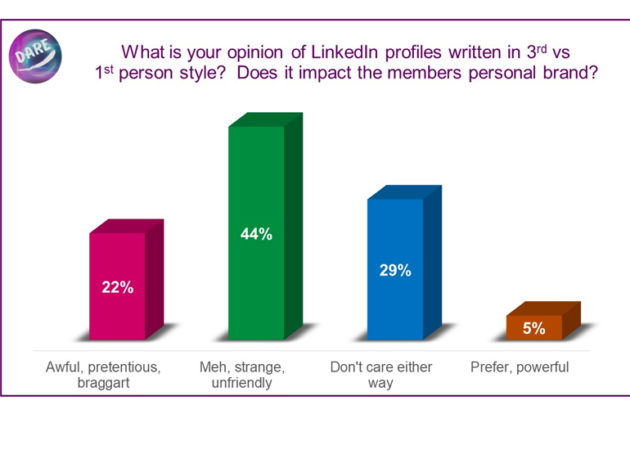
The poll logged 199 votes together with a wide range of additional opinion both publicly and privately. Further, after the Poll had closed I received another 28 messages with feedback aligning to the final metrics.
Interestingly, 72 per cent who voted ‘Don’t care either way’ used the 1st person in their own profiles, 21 per cent the 3rd person and 7% didn’t even have a profile summary at all.
And surprisingly, 55 per cent who voted ‘Prefer/Powerful’ used the 1st person in their own profiles. A few commented that if they had the courage or ability, they would have written in the 3rd person.
Many shared they judged profiles by the individual and their needs and were not fussed as they would still be in contact to find out more. Whereas others were quite turned off and the perception of the person’s brand was not favourable to say the least.
A wide range of sectors, roles and levels were represented as were genders and age ranges. And within specific industries, there was no linear preference to style. Conservative and creative professions had equal divides of opinion which refutes the notion that certain sectors lean towards a preference, for both using and engaging.
Humans are unique and as the world becomes more fractured the desire for greater engagement and sense of relationship is stronger than ever. Be human and inviting.
I asked a few communications experts to share their feedback:
I am a fan of the first person as it allows you to be a bit more personal and I feel the first person allows you to bring in your own voice and personality. ~ Gabrielle Dolan, Storytelling expert, Author of ‘Stories for Work’ & ‘Real Communication’
‘Writing a LinkedIn profile in the third person introduces distance, unfamiliarity, and disconnection. First-person invites readers in and shares with them your world of triumphs and the lessons you learned to achieve them’ ~ Kieran Bicheno, Online News Editor & Economist
‘We live in an age where there’s so much talk about being vulnerable, real and authentic. When you write your profile in 3rd person, it is like slamming a barrier between you and the reader; stiff, rigid, with no personality. How are people meant to connect with you if you don’t give them access to you?’ ~ Annette Densham, PR Strategist, the Audacious Agency
There is a rule in advertising and marketing that it’s not about your own opinion that matters but what the broader market opinion is. And whilst these statistics are a micro survey of sorts. I am totally confident that it represents the heartland of consensus which is also supported within LinkedIn specialist communities globally. Be human and impress.
Comments