


Busyness vs. productivity: Beware Web3’s mental health traps


The business world is embracing Web3 in a big way but is it at the expense of our already-tenuous mental health? CEO of Collective Campus, Steve Glaveski, warns of the mental health traps inherent in an always-on digital workplace.
Disclaimer: If you are struggling with mental health, please consult a professional. You can find a list of free support services available in Australia at the bottom of this post.
The Web3 ecosystem is bustling with unbridled energy, enthusiasm and excitement.
Look no further than crypto Twitter to bear witness to the amount of activity in the space, buoyed by the untapped opportunities it presents; reminiscent of the early days of Web1, or even, the American expansion into the then wild west.
Lifestyle guru, Tim Ferriss, says that many of his Web2 friends have “dropped everything” to cultivate careers in Web3.
In fact:
Silicon Valley is no longer the edgy tech frontier … Web3 is.
But all of the novelty, excitement and seemingly unequaled opportunities presented by the space can leave us vulnerable.
Having joined the ranks of those pivoting to Web3 in 2021, I was struck by how little discourse there was around – or appreciation for – how we work.
This is especially true for the hordes of 20-somethings in the space, many of whom have limited professional experience and haven’t thought much about better work habits, confusing busyness with productivity.
As someone who spent the better part of the past four years thinking about, researching and experimenting with better work practices, culminating in my book Time Rich, a handful of Harvard Business Review articles, and a talk at SXSW 2021, red flags became very apparent to me, very quickly.
All the more so when I attended SXSW this year (2022), with numerous conversations I had with Web3 founders touching on excessive hours, lack of sleep, a sense of burnout and information overwhelm.
And just this week, NFT thought leader Zeneca shared this tweet on his own struggles with mental health, despite making great strides forward in the NFT space.
This compelled me to write this article.
I’ve attempted to distill a lot of what I’ve learned into a reasonably short (if you consider 3,000+ words short) and actionable post for people entering, or already deeply immersed in, the Web3 space, with links to further reading, drawing on scientific literature, anecdotal evidence and ancient wisdom.
I hope that it will prove useful to some of you reading this.
If we are to leverage Web3 infrastructure to coordinate people at scale and deploy human effort in a way that drives positive cultural, economic and social transformation, we must do it in a way that both gets the best out of our collective cognitive potential, and is sustainable.
Without further ado, I bring you the mental health traps to look out for in Web3.
Whether it be competition to get in on the latest NFT drop, the FOMO that comes with being immersed on crypto Twitter and the first-mover opportunities in Web3, or simply acquiring followers on Instagram, crowds can lull us into doing things for the wrong reasons.
If everybody else seems to be valuing or doing something, then we should probably do the same, right? Wrong.
As Roman Stoic philosopher Seneca put it, “Do you ask me what you should regard as especially to be avoided? I say, crowds; for as yet you cannot trust yourself to them with safety … To consort with the crowd is harmful; there is no person who does not make some vice attractive to us, or stamp it upon us, or taint us unconsciously therewith. Certainly, the greater the mob with which we mingle, the greater the danger …”
As Naval Ravikant puts it – play stupid games, win stupid prizes.
Competition can blind us to what really matters.
There are few surer paths to anxiety and sickness than not living a life true to ourselves.
To counter this, define what your core values are, who you want to be, and strive to align your actions with your values — not what everybody else values at the moment.
“Once I get that person, then I’ll be happy,” we tell ourselves.
“Once I get that promotion, then I’ll be happy.”
“Once I get that NFT, then I’ll be happy.”
“Once I have a 7-figure crypto portfolio, then I’ll be happy.”
But such happiness is fleeting.
Hedonic adaptation or ‘the hedonic treadmill’ ensures that despite whatever major life changes we go through, we quickly return to a predisposed level of happiness. Harvard psychologist, Tal Ben-Shahar, calls the arrival fallacy “the illusion that once we make it, once we attain our goal or reach our destination, we will reach lasting happiness.”
This is especially true when it comes to income. As Daniel Kahneman and Angus Deatonfound in an oft-quoted study, emotional wellbeing rises with income, but there is no further progress beyond an annual income of US$75,000. Low income, on the other hand, exacerbates the emotional pain associated with such misfortunes as divorce, ill health and being alone.
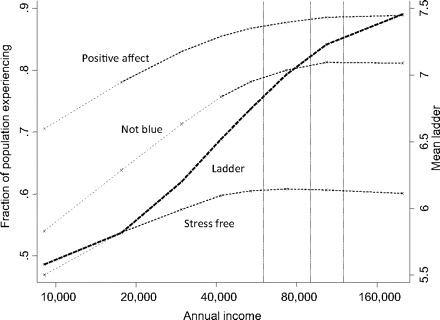
Source: https://www.pnas.org/content/107/38/16489
It might sound cliche, but what really matters is the journey rather than the destination — doing meaningful work, and cultivating meaningful relationships doing it.
Gary Vee often talks about buying the New York Jets but as he told Adam Levy on an episode of Mint, this is because trying to buy the Jets gets the best out of him — it sets him up to take a long journey towards a goal.
Buddhist philosophy teaches us that happiness and contentment come not from without, but from within — by truly accepting who we are and being content with what we have, removed from the things we acquire.
Yes, we can strive to become someone we envisage becoming, but we stand a better chance of becoming if we truly accept being who we are today.
Be objective and define your real ‘enough’, and consider anything above and beyond that a bonus.
Deep work or the ‘flow state’ — full, undivided immersion in a single challenging activity for extended periods of time — is both professionally and physiologically rewarding.
According to McKinsey, we are up to five times more productive when we’re in flow and emotionally, we walk away from these experiences high on a cocktail of dopamine, serotonin, endorphins, norepinephrine and anandamide — responsible for ‘the runner’s high’.
But here’s the thing … every time we’re interrupted or switch tasks, it can take us about 23 minutes to get back into flow. This is also known as a cognitive switching penalty. Not only does it deprive us of our cognitive powers, but each time we switch tasks our brain has to orient around a new context and information, slowly sapping our energy and leaving us progressively exhausted the more we do it.
In the world of Web3, characterised by Discord communities, Telegram chats and endless scrolling on Twitter, it can be easy to be ‘busy’ all day on shallow tasks but have little to show for it.
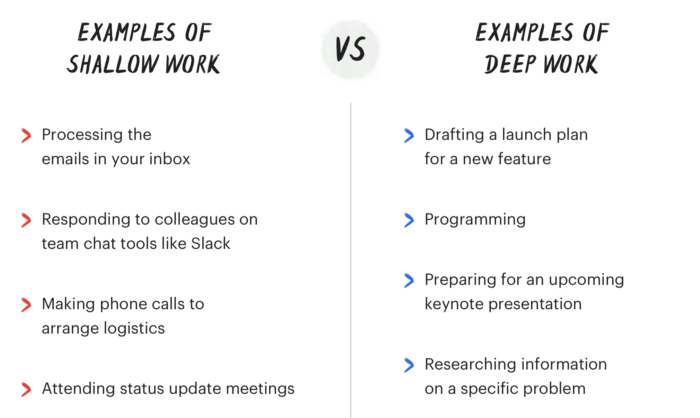
Source: Doist blog
Author of Deep Work, Cal Newport, says that four hours a day is the upper limit for flow. So to counter the lure of shallow work — which is easy but unrewarding — block out four hours a day in your calendar for deep work, and do away with all distractions — Discord, Slack, your smartphone — during this time.
It might be difficult at first if you’re particularly prone to switching all day long, but like training a muscle in the gym, it gets easier the more you use it, and once you see those gains — more outcomes in your work, and feel-good chemicals — you will be motivated to keep summoning the flow state.
According to screen logging SaaS platform RescueTime, people are switching screens or tasks once every 40 seconds — whether to Discord, Telegram, email, Slack, social media, or some other app often masquerading as a work tool.
The rate of screen switching is probably higher in Web3, where the perpetual background hum and chatter of Discord seems to be the default browser setting for most people working in the space.
And every time we receive a message or a mention, our brain lights up with a micro-hit of dopamine, prompting us to effectively see Discord as — to paraphrase The Social Dilemma’s Tristan Harris — an emotional slot machine in our pockets and desktops.
We can become addicted to checking Discord, but this can quickly become unhealthy and come at a cost to our productivity.
A tool is only as good as how you use it.
To counter Discord addiction:
The more intentional your use of Discord becomes, the easier it will be to not mindlessly check it 347 times a day.
The above holds true for Slack and other social media platforms.
We can derive a great sense of identity and security from our work, and society tends to look favourably upon the person putting in long hours.
As such, it’s easy for us to justify working far beyond the point of vastly diminishing returns at the expense of getting out of our comfort zones and cultivating meaningful face-to-face relationships, working on our health and fitness, and pursuing difficult pursuits IRL. Incidentally, these are all things that contribute to living a rich and healthy life.
As Bronnie Ware, a palliative care nurse and author of Five Regrets of the Dying, wrote, one of the major regrets people on their deathbed have is wishing they didn’t work so much.
Seneca’s ancient musings on how we choose to spend our time put it well: “We are stingy with our money and possessions, but wasteful with our time which is the one thing it is right to be stingy with because time unlike money cannot be earned back once we’ve spent it.”
Don’t get me wrong, work can be a great source of inspiration, joy and connection. But everything has its point of diminishing returns where the trade-offs aren’t justified. If you’re honest and objective with yourself, you’ll know what that point is, and when you should close your laptop and go and do something else.
This could fit under ‘Competition is blinding’, but I feel it deserves an entry of its own.
Hustle culture, espoused by folks like David Goggins and numerous entrepreneurial influencers, tells us to work harder, to work longer, to sacrifice to no end, if we want to win.
But as Matthew 16:26 states, ‘what will it profit a man if he gains the whole world yet forfeits their soul’?
Oftentimes, hustle culture can just be a crutch of its own, and the very same people espousing the merits of hustle culture have long harboured their own insecurities that they think forever hustling will allay them of, or at the very least, distract them from said insecurities and feelings.
If you find yourself mindlessly subscribing to #hustleculture, ask yourself whether the way you are working is truly sustainable. If it’s not, is it really going to help you reach your goals, or is it just going to leave you burnt out, depressed and devoid of enthusiasm for your work?
By all means hustle, but hustle for the right reasons, and in a way that permits you to work at a high level for a long period of time, without slowly chipping away at your relationships, and your physical and emotional health.
Another trap people fall into here is that they tell themselves “I’ll hustle to get to Point B”, but the goalposts forever shift. You don’t just turn it off when you get to Point B, but you start hustling to get to Point C, and this forever becomes your modus operandi, until you either burnout or die.
We should approach our work how an NBA team approaches its season — with rest punctuating work, complete with off-seasons, regular seasons and playoffs, all calling for different levels of effort.
A report by NIOSH (National Institute for Occupational Safety) found that workplace stress is attributable to key factors such as excessive workload, people issues, work-life balance conflicts, lack of control, and a lack of purpose.
Almost mindlessly buying and flipping NFTs, purely to speculate on price increases, will probably wear you down over time because, apart from making some quick bucks, the activity is fundamentally devoid of purpose and genuine contribution to the world. We might start to feel like we don’t matter.
As Ukrainian president Volodomyr Zelenskyy told reporters recently in the midst of the war with Russia, “life is wonderful right now because I am needed.”
There are few things more important to our mental health than to feel needed, loved and seen.
Simply doing something for the money is not at all removed from the lawyer or investment banker who is making tons of cash, but fundamentally hates their 12-hour-a-day job and lives for cocaine benders on the weekend to gain a temporary emotional reprieve from their dire existence.
Whatever you’re pursuing in Web3, make sure you truly believe in the mission and purpose and that it aligns with your core values, interests and strengths.
While you might think you can burn the candle at both ends, it will eventually catch up with you.
Sure, you can join and contribute to 15 DAOs, but just how meaningful will your contributions be in the long run?
To help mitigate your workload, contribute only to a number of projects that permit you to operate at your highest level. Prioritise high-value activities and consider automating, outsourcing or eliminating everything else. Skip unnecessary calls or meetings, and practice asynchronous communication to the best of your abilities so that you can spend as much time doing deep work as possible each day.
The use of task boards to capture and better manage your workflow, and communicate to others what you’re working on without actually having to correspond in real-time, can also be transformative.
Do all of this, and you might find that six hours a day is sufficient to get you to your goals.
As Cal Newport wrote, humans have evolved to build strong social connections with family, close friends and community through face-to-face interactions that require non-trivial sacrifices of time and energy.
Discord chats and Zoom calls are no substitute for this.
Newport went on to say that social media reduces our sociality to low-friction online likes and comments, which provide a simulacrum of connection, but are barely recognised by our primal brain as socialising at all — leaving us paradoxically lonelier.
And loneliness has been found to have the same mortality risk as smoking 15 cigarettes a day, making it even more dangerous than obesity.
So while you might tell yourself that you’re being social on Discord or Twitter Spaces, your brain isn’t buying it.
Make time for face-to-face human interactions and conversations, and make sure to cultivate meaningful and deep romantic, familial and social connections IRL.
According to Matt Walker, professor of neuroscience and psychology at the University of California and author of Why We Sleep: The New Science of Sleep and Dreams, there are numerous reasons why most people need to be getting eight hours of sleep a night — or at least seven.
Sleeping enriches a diversity of functions related to learning, memory, creativity, emotional regulation and decision-making.
The majority of our deep sleep or rapid-eye-movement sleep (REM) — key to emotional regulation and clearing emotional cobwebs — happens between the sixth and eighth hour of a sleep cycle. But if you’re only getting five hours of sleep a night, you’re missing out on most of this tonic.
Many folks I speak to in the Web3 space talk of late nights, early mornings and a lack of sleep — especially true for people in non-US countries who wake up early to get in on NFT drops.
While we might not always be able to get a perfect eight hours, we should strive to get as much quality sleep as possible, as frequently as possible.
Read my post on 10 ways to get a good night’s sleep for actionable steps you can take. Oh, and getting some direct sunlight first thing in the morning, even on an overcast day, will set your circadian rhythm to begin releasing melatonin 14 hours later, setting you up for an easier trip to lala land.
The stereotype of the gamer spending all day in a dark basement playing Halo or Fortnite, subsisting on a diet of pizza and Coke, doesn’t scream healthy lifestyle. But this can also be par for the course for many folks working in the Web3 and crypto world.
But physical activity and movement isn’t just good for the body, but it is good for our emotional health and cognitive abilities.
As the University of Illinois found, the brain lights up like a Christmas tree after a short walk, as our brain releases BDNF (brain-derived neurotrophic factor) — associated with cognitive improvement and the alleviation of anxiety, and adrenaline — key to focus.
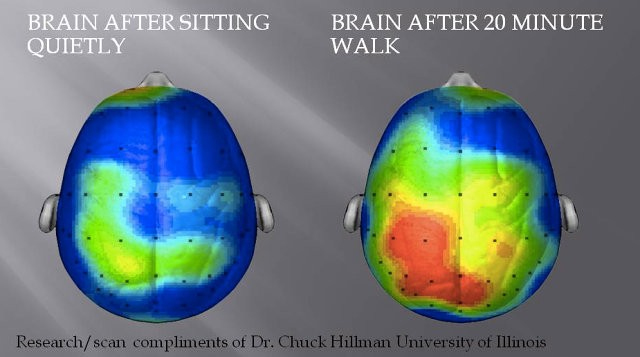
A separate study found that exercise reduces stress-induced overexcitability of the amygdala, the brain’s threat detection system, restoring homeostasis and returning us to a baseline level of emotional wellbeing.
You don’t need to run a marathon or give Ronnie Coleman a run for his money in the gym, though.
A 2014 study found that just 20 minutes of aerobic exercise at just 40 per cent of your maximal power or output increases BDNF levels, and that frequent aerobic training — think running, walking, cycling — for 45 minutes, three times a week for 12 weeks magnifies this increase.
A logical extension of exercise is eating well.
Eating well is not only good for your health and sustained focus at work, but comes with myriad mood-boosting benefits.
The B vitamins you find in complex carbs like whole grains are vital to brain health, and B12, in particular, is involved in the production of neurotransmitters such as serotonin and dopamine, both of which help to regulate mood.
The folate you find in complex-carb and fibre-rich foods such as green vegetables are also associated with the production of serotonin, dopamine and noradrenaline.
The omega-3 fatty acids you find in fatty fish, nuts and chia seeds not only support brain functioning but were linked with a lower likelihood of depressive symptoms in a meta-analysis published by the Journal of Epidemiology and Community Health, which reviewed 26 previous studies involving over 150,000 participants.
A 2017 review published in the Annals of General Psychiatry looked at ten previous studies, the majority of which found positive effects of probiotics on depressive symptoms. Foods rich in probiotics include yoghurt, sauerkraut, kimchi and pickled vegetables.
So before you order that burger and chips from Uber Eats, consider some healthier alternatives.
Web3 is populated with folks from all over the globe who tend to work remotely. This means that their daily commute has been reduced to a short stroll from the bedroom to the study (or the kitchen table). While convenient, this can come at a significant cost to our mood.
Direct sunlight exposure (as opposed to indirect sunlight exposure through a window) plays a number of critical and foundational roles when it comes to optimising our health and mental performance.
A 2008 study found that ultraviolet rays (UVR) increase the body’s production of endorphins – a natural opiate that relieves stress, pain, and can produce a feeling of euphoria also known as the ‘runner’s high’ — that buzz you get after running a few ks.
Light has also been found to modulate serotonin, which is involved in mood regulation.
If you only take one thing away from all of this, perhaps it’s this.
Be kinder to yourself.
We often talk to ourselves in a way that we would never talk to someone we care about. We are super self-critical and never enough.
By reminding yourself that, actually, you are enough — and that no amount of NFTs or social credit on crypto Twitter will change that — you can liberate yourself to pursue things for the right reasons, in alignment with who you truly are.
And there are few things more important than living a life true to yourself.
This article originally appeared on steveglaveski.com, read the original here.
Join the soloist movement. Whether you are new to Flying Solo or looking to grow your business, our membership options will help you attract more leads, grow your network and sharpen your business skills. Sign up to our newsletter to get the latest news and advice straight to your inbox.
Now read this:
//corestage-cdn.flyingsolo.com.au/business-technology/technology/how-traditional-businesses-can-take-advantage-of-web3/
Comments