


Banish the guilt! 3 ways to practise strategic procrastination


We’re all bitten by the procrastination bug from time to time, but if it is getting in the way of good business practises – or life in general – maybe you need to learn the practise of ‘strategic procrastination’ instead, writes Kelly Exeter, former Flying Solo editor.
Anyone who’s ever had a looming deadline, tricky email to write or BAS to submit is familiar with procrastination – the act of delaying or putting off tasks until the last minute.
What’s the worst thing about procrastination? It’s the guilt trip that comes with it.
We know what we should be doing. We know we’re not doing it. And we feel frustrated that we can’t just get our act together and make it happen.
What if there was a way to procrastinate, but without the guilt? After much trial and error over the years, I’ve found such a way.
I call it strategic procrastination.

While regular procrastination just puts off tasks until they HAVE to be done, strategic procrastination takes a more deliberate approach to the delay.
Here are three examples:
Staring at a blank page or a spreadsheet full of numbers and willing yourself to do something already is not fun. If you’re anything like me, the second you get stuck, your mouse hand will be twitching to take you to Facebook or Twitter for a ‘little break’.
Unfortunately, scrolling mindlessly through a social media feed or heading down an unexpected rabbit hole will drain your energy, not boost it. Which means that when you return to your blank page or spreadsheet, the only thing that will have changed is you’ll be less inclined to tackle the work at hand, not more.
Getting away from your desk, heading out the front door and doing as little as a five-minute walk around the block is a guaranteed mental refresher. The combination of fresh air and a moving body means when you get back to your desk, you’ll have reset your mind and boosted your energy.
And chances are, if there was a problem that was blocking you from starting or finishing the job before you left your desk, you’ll now have a solution for that problem.
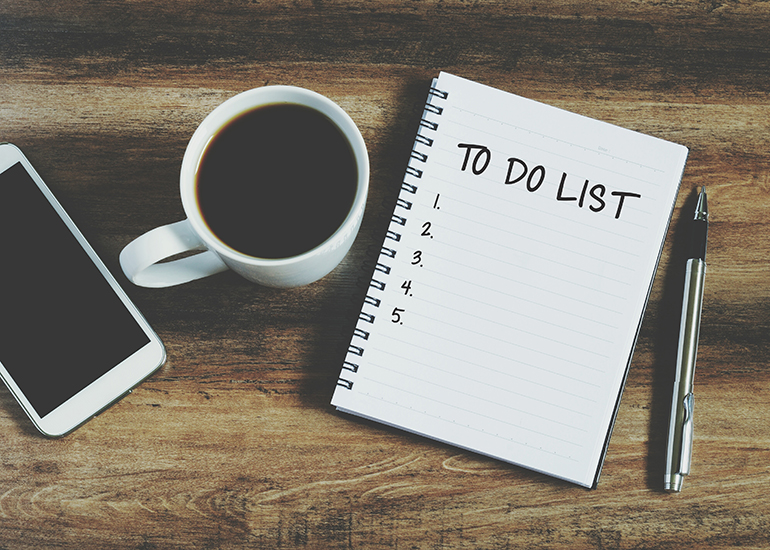
When we have a particularly big or hard thing to do, we put all kinds of weird barriers around when it can be done.
‘When I have some good head space.’
‘When I can sit down for three hours uninterrupted and smash it out.’
Problem is, these ‘waiting until the time is right’ scenarios don’t tend to present themselves all that often. Also, if you’ve ever left something until right on deadline and just had to get it done – and got it done pretty well – you’ll know the whole ‘when the time is right’ thing is a fallacy.
My tried and tested form of strategic procrastination for these big and hard things is to set things up to marinate. In the same way you can do a little bit of pre-work in seasoning meat to cook a beautiful meal the next day, you can do a little bit of pre-work in setting yourself up to tackle a big job the next day.
What this looks like on a practical level is this: the day before you’re going to do the big job, sit down and just do a big brain dump. You can record yourself speaking into a Google doc. You can type or write out ideas, thoughts, sketches, sentences and questions. The important thing to know is that whatever pours out of you on to the page doesn’t need to ‘make sense’. It’s actually not what’s on the page that matters, it’s what happens in your brain after.
And what’s going to happen is your brain is going to mull over things and notice things it didn’t notice before you did the big brain dump. The ideas and thoughts you’ve unlocked are going to marinate overnight. And when you return to the task the next day, you’re going to be surprised by what you’re able to cook up as a result.

When we’re avoiding doing something, but want to feel like we’re doing something useful, there’s no better place to head than our inbox. In there will be some emails that can be quickly replied to – an activity that makes us feel like we’re doing something useful and necessary to our business. Also, clients love responsiveness on email, right?!
But responsiveness on email can be a trap. The more responsive you are, the more emails you send. The more emails you send, the more replies you get that require responses. Also, the more responsive you are, the more people will use you to do their thinking for them (it becomes easier to email you for information than to search for the answer themselves).
I know this because I used to be a devotee to over-responsiveness on email. It was only when a business situation took me away from my inbox for a while that I saw how many ‘urgencies’ resolved themselves (or were resolved by others) when I was unable to respond quickly in the moment. It was pretty eye-opening, and I started to experiment with dialling back my responsiveness from there.
Today, I am devotee of strategically procrastinating when it comes to email. It’s made me a lot less stressed and a lot more productive when I’m at my desk.
And I’m also a devotee of strategic procrastination in general. Giving yourself permission to procrastinate – and being smart about how you do it – eases the guilt that normally goes with procrastination. And gives you a productivity boost too!
Join the soloist movement. Whether you are new to Flying Solo or looking to grow your business, our membership options will help you attract more leads, grow your network and sharpen your business skills. Sign up to our newsletter to get the latest news and advice straight to your inbox.
Now read this:
//corestage-cdn.flyingsolo.com.au/uncategorized/5-steps-to-productivity/
Comments