


10 laws of nature every entrepreneur needs to know


The internet is littered with techniques and hacks from successful and some not-so-successful entrepreneurs that are said to help increase your chances of entrepreneurial success.
But as I wrote previously, and as the great Richard Feynman noted, when it comes to advice, it’s critical that there is symmetry in circumstance. More often than not, advice dished out online is circumstantial, and what worked for one business won’t necessarily work for another because there are simply far too many moving internal and external parts.
This is why bringing a business idea that worked well ‘overseas’ to your country doesn’t always work because of a deviation in factors such as household income, cultural norms, geographic distribution, population size and demographics, competitive landscape, supply chains, regulation, and so on.
However, if you’re looking for all-encompassing principles that transcend the boundaries, then you should look to universal laws of nature. Such laws hold true not just in business, but everywhere in the physical world.
Becoming a student of these laws and deferring to them when you’re making strategic decisions can give you a significant advantage in not just your entrepreneurial life, but in your personal life too.
It’s easy for entrepreneurs, high on the dopamine hit of coming up with an idea and seeing their face on the cover of Entrepreneur magazine — to jump to conclusions and waste valuable time and money building and taking the a product nobody wants to market.
By reminding ourselves of Murphy’s Law we’re more inclined to:
While a good dose of Steve Jobs’ reality distortion field might help us pursue ideas most people think are crazy — it’s a very fine line between being a visionary and being plain naive, and being the latter is orders of magnitude more common.
First articulated by Cyril Parkinson in The Economist in 1955, this law is of utmost important to entrepreneurs who are short on time, money, or both (basically all of them), and is an especially worthwhile reminder for those entrepreneurs who spent some time working in the corporate world and picking up all sorts of bad time-wasting habits.
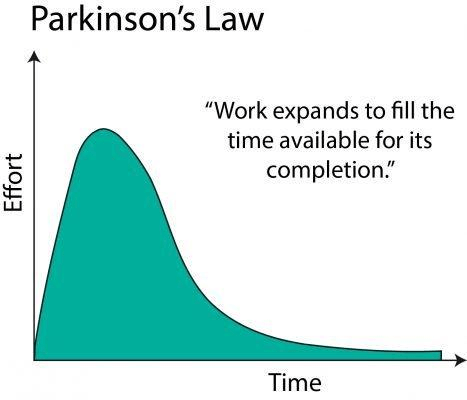
Essentially, if you give yourself a month to do something you’ll get it done in a month.
If you give yourself a week to do something you’ll get it done in a week.
Giving yourself less time to do something acts as a forcing function and gets you to focus on what matters, do away with procrastination and wasteful activities, and get stuff done.
Set aggressive but realistic timeframes.
Founded by Italian engineer Vilfredo Pareto in the 19th Century, this power law can generate disproportionate returns to your business.
It can be applied to your customers, products, tasks, marketing channels, sales reps, and so on. By identifying which 20 percent of input X generates 80 percent of output Y, we can spend more time and money on X instead of on activities, customers, sales reps and so on that aren’t pulling their weight.
If 20 percent of your customers generate 80 percent of the revenue, then it stands to reason that you should spend more time cultivating those relationships and relationships just like them.
If 20 percent of your marketing activities are generating 80 percent of your sales, then you should — providing you’ve not exhausted that channel — spend more money on these high-performing activities instead of on lower-performing ones.
Read more: Super Mario and the 80/20 Principle
Closely related to the Pareto Principle, but applied to an organization’s talent, Derek Price’s law suggests that if 100 papers are written by 25 authors, the square root (5) will have contributed 50 papers. The same, he found, holds true when it comes to company headcount.
Chances are, if you have 20 people on your team, about 5 would be generating half the value.
I’ve also found this to be true in my own organization’s downscaling efforts.
Promote, terminate, automate, outsource, and incentivize accordingly.
Read more: Why You Should Fire (most of) Your Team
5. Goodhart’s Law — when a measure becomes a target, it ceases to be a good measure
Named after British economist Charles Goodhart, this law is particularly true of KPIs and OKRs.
If your bonus is based on a specific KPI being met, then you will do whatever you can — including accounting trickery — to hack those numbers. Or you might focus solely on achieving those numbers at the expense of everything else holding a company or team together.
If Airbnb execs focus solely on improving nights booked with an aggressive marketing campaign, at the expense of the customer experience, then they might find that nights returned falls to zero, and the company develops a bad reputation very quickly.
In the sales world, hastily put-together KPIs can lead to unhealthy competition amongst sales reps that might extend to sabotage and secrecy when it comes to sharing valuable customer and sales insights.
When setting KPIs, consider how they might be gamed and what the unintended consequences of them might be.
There is a tendency for entrepreneurs to fall into the trap of linear thinking.
“We’ve been growing by 10 percent per month, so by this time next year we will be making $X”.
However, few things keep rising at the same rate forever. As the old adage goes, ‘what goes up must come down’.
Being aware of this will temper your expectations and projections so that you make more informed decisions and strategic choices. The same holds true about external factors such as market growth rates, so be wary of this the next time you include CAGRs in your pitch deck to potential investors.
7. Newton’s First Law of Motion — an object will stay in motion until acted on by an unbalanced force
Understanding Isaac Newton’s first law of motion can help us and our teams overcome inertia, beat procrastination, and deliver value.
We are biologically predisposed to taking the path of least effort — like checking Twitter for the 17th time today — instead of getting started with a more difficult task that requires we expend some cognition.
However, by taking the smallest possible step instead of terrorizing ourselves with the entire task at hand (for example, writing the first 50 words of a 2,000 word article), it becomes much easier to keep going now that the object is in motion.
Read more: Reach Your Goals Fast with Isaac Newton’s Laws of Motion
This is specifically true of projects and tasks. It’s easy to work on something long after we’ve delivered sufficient value, but having a good relationship with the point of diminishing returns can be the difference between high performers and everyone else.
High performers stop and move on to something else when they reach this point. The rest of us are inclined to tweak the formatting and wording in a sales presentation for about as much time as it took us to create the presentation in the first place. Know when value has been delivered and move on to something else.
Failure to do so is akin to Forrest Gump storming into the changerooms after scoring a touchdown.
9. The Law of Compounding
There is a tendency for entrepreneurs to get discouraged by overestimating how much they can achieve in the short run, and underestimate how much they can achieve in the long run.
By focusing on getting a little better every day, and having an appreciation for the law of compounding, entrepreneurs can more readily play the long game.
For example, a 1 per cent improvement in X every day equals a 37-times improvement come year-end (of course, not all things can grow at a linear rate forever, as we saw in rule 6).
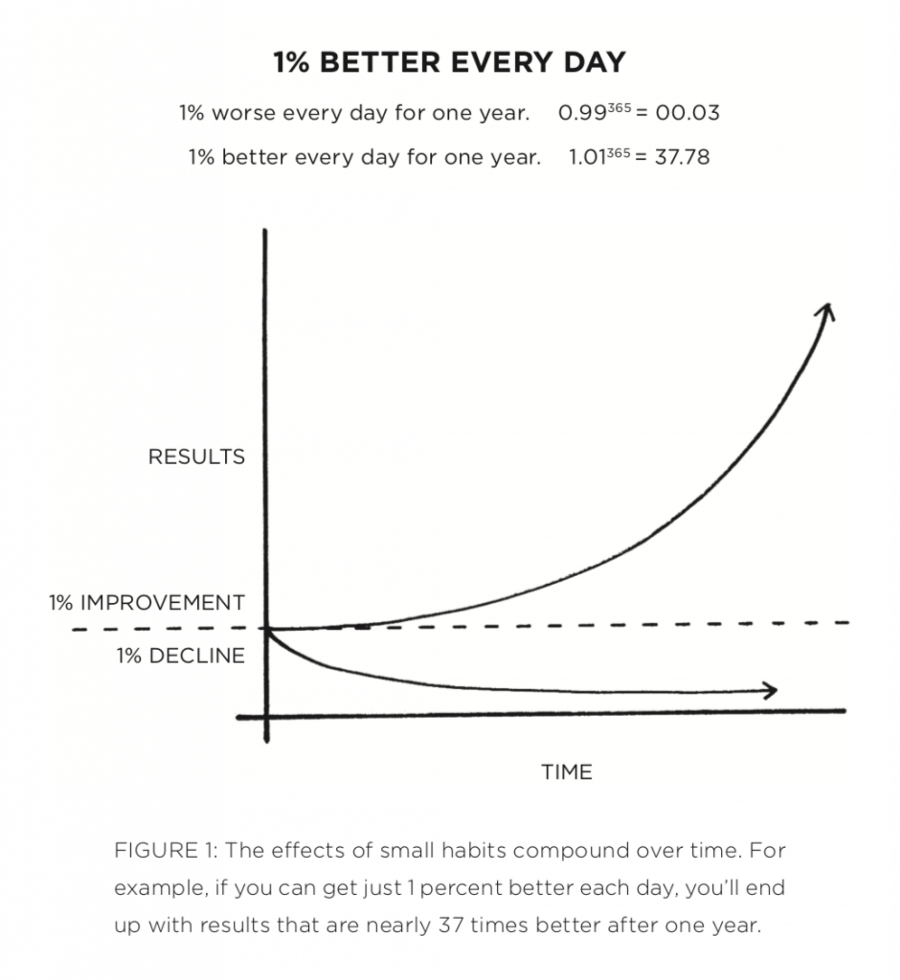
You can use the ‘rule of 72’ to determine how long it would take for the output or value of X to double based on a constant percentage increase. Take 72 and divide it by the improvement percentage to get your result. For example, a 5 percent improvement in revenue each month would result in revenue being doubled in 14.5 months (72/5).
Determine what variable matters to you, what you can do to increase it ‘just a little’ every day, week or month, and then set sail for distant lands.
As former US President, Calvin Coolidge, famously stated, nothing in this world will take the place of persistence, talent, education and genius will not — persistence alone is omnipotent.
But your ability to persist has a lot to do with the belief you have in yourself, your team and your ability to succeed. This will have a lot to do with the opportunities you’ve decided to pursue, and how well-positioned you are to capitalize on said opportunities.
How mature is the market? How much demand is there? How satisfied is the market with existing solutions? How differentiated is your solution? Do you have a competitive advantage? Can you build the solution? Can you sell it? Can your challenges be overcome? Have you overcome such challenges before?
These are just some of the kinds of questions that you need to answer affirmatively to develop said self-belief.
With that said, if you can do something that you’re passionate about, good at, and that makes money, you’ll be better off than a lot of entrepreneurs.
Join the soloist movement. Whether you are new to Flying Solo or looking to grow your business, our membership options will help you attract more leads, grow your network and sharpen your business skills. Sign up to our newsletter to get the latest news and advice straight to your inbox.
Thei article originally appeared on steveglaveski.com You can read it here
Now read this
//corestage-cdn.flyingsolo.com.au/live-smarter/work-motivation/the-key-to-success-in-entrepreneurship-believe-in-yourself-and-st/
Comments