


Is an EV right for my business?


As a solopreneur, your vehicle can be the key to your livelihood and yet one of the biggest costs for your small business. But we’ll let you in on a little secret … there’s no better time to incorporate electric vehicles (EVs) into your business. With government subsidies, potential cost savings and tax incentives, you’ll also lessen your impact on the environment. And the transition is easier than you might think. Here’s a step-by-step guide to get you started.
Is it just you that needs the vehicle? Or will other staff members drive it too? What do you use your business vehicle for? How far does it travel? How much is it costing you?
These are the key questions to ask, according to Chau Le, General Manager, E-mobility at Origin Energy and Chair of the Electric Vehicle Council.
“Also consider where the vehicle is parked during the day and night, as this will drive strategy around charging solutions,” she told Kochie’s Business Builders.

Beyond typical size and storage considerations, EV-specific factors such as battery capacity and driving range are crucial. Many modern EVs can travel 400km or more on a single charge.
“For sales staff travelling within metro and urban areas, a standard-range vehicle like a sedan or small SUV is perfect,” says Chau. “For staff needing more storage capacity and travelling longer distances, consider larger SUVs and long-range models.”
There are now several ways to charge EVs.
“The simplest way is to plug it into your regular electric socket at home,” says Chau, who’s done this with her own EV for the past 2.5 years. “It takes longer to charge but if you’re only driving 30km a day, plugging it in three times a week should do the trick.”
Or you can install a dedicated charging station at your home, garage or workplace premises, which costs around $2500 and significantly speeds up the charging process. These stations often come with an internet connection, allowing remote control of charging times. Plus you may be able to enrol in a smart charging program where you can earn money from energy retailers for charging your car. How cool is that?
More good news on this front: funding from the federal government’s Australian Renewable Energy Agency (ARENA) may be available to help businesses cover the costs of installing charging infrastructure for electric vehicles.
Origin can help businesses access this funding through its EV Flex Plan.
“This subsidy can cover the standard hardware and installation,” says Chau. “So it’s a really good program for businesses to tap into.”
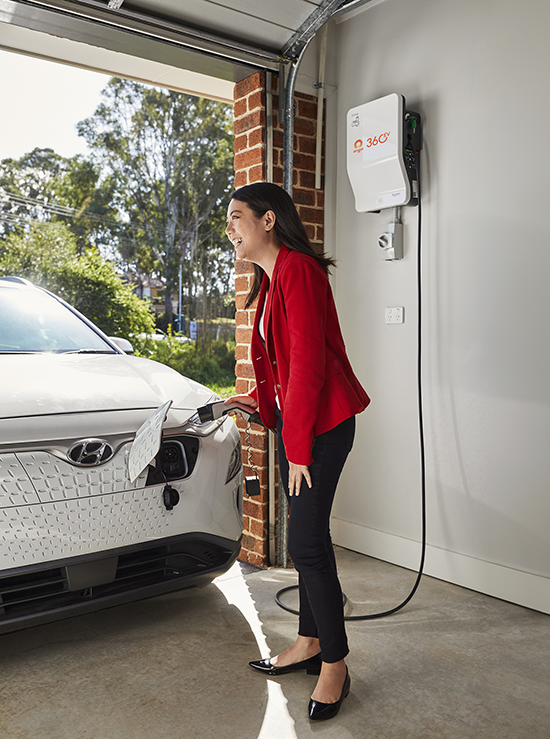
Finally, there’s the option of public charging stations that are popping up all over the country. For example, you could plug your vehicle into a charging station at your supermarket and get a full charge in 15 minutes while you’re shopping for groceries. You can find a list of public charging stations on the Plug Share website.
Worried about the cost of buying a new EV? Don’t be! You can manage these costs by leasing EVs or taking out a subscription (see step 5).
Also, the cost savings with an EV are substantial, starting with fuel.
“With a petrol vehicle, if you spent $2500 a year on fuel, the electricity costs to charge an equivalent EV would only set you back around $800 – a saving of 70 per cent**,” says Chau.
Maintenance costs for an EV can also be much lower. “There are fewer cogs in the engine to maintain,” says Chau.
You also get to save tax when you switch to an EV for your business. Normally, if you use any of your business vehicles for personal use, you have to pay fringe benefits tax (FBT). “This can cost the business anywhere up to $10,000 a year,” says Chau. “But eligible EVs are exempt from FBT.”
And don’t forget the government subsidies, which vary from state to state and won’t be around forever. While they’re available, they can significantly reduce your initial costs. For example, in New South Wales, incentives are available to help businesses switch their fleets to EVs.
Instead of buying and maintaining one or more EVs for your business, you could consider a subscription service to take the hassle out of the process.
The Origin 360 Flex Plan is a full-service solution where you pay a fixed monthly fee that covers use of the vehicle, registration, comprehensive insurance, roadside assistance, toll management, and scheduled maintenance. Plus, because Origin 360 EV Flex plan is a month-to-month subscription, you can try an EV knowing that if it doesn’t suit you and your business or if things change, your EV can also change by switching vehicles or ending your subscription***.
Origin offers a wide range of EVs, from small cars to larger vehicles and electric vans, and its expert consultants will help you choose the best options for your business, as well as guide you on the right charging solutions.
“We designed this very flexible subscription solution so small business owners can benefit from the savings potential of EVs now, with everything taken care of,” says Chau.
Ready to make the switch? Find out more about the Origin 360 Flex Plan.
Important information
* Department of Infrastructure, Transport, Regional Development, Communications and the Arts and Department of Climate Change, Energy, the Environment and Water, 2023.
** Electric Vehicle Council ‘Will I save money owning an electric vehicle in the long run?’
***Annual vehicle swaps available on contracts greater than 36mths. Subscription cancelation requires 30 days notice. Cancellation fees may apply. https://www.originenergy.com.au/electric-vehicles/business/flex-plan/#important
The content provided is general and has not taken into account your objectives, financial situation or needs. Origin recommends that you seek your own independent legal, financial and tax advice when making any decisions in respect of the appropriateness of the EV Flex Plan for your circumstances – see full details here.
This article was originally published on Kochie’s Business Builders in partnership with Origin Energy.

Comments